 Add to Chrome
 Add to Firefox
 Add to Edge
Multi-Floor Exploration for Ground Robots via an Incremental Reachable Graph and Structural Priors
May 22, 2026
Autonomous exploration of multi-floor buildings remains challenging for ground robots because conventional 2D and 2.5D maps cannot represent overlapping traversable surfaces such as stairs, ramps, and multiple reachable elevations. This letter presents a multi-floor exploration framework based on an incremental reachable graph. Built as a sparse graph over reachable support surfaces, the graph preserves potentially valid connectivity through tentative graph elements under sparse observations and enables stable, physically reachable frontier detection. To guide exploration beyond the currently mapped floor, we project task-zone priors from an explored floor to initialize a hypothetical graph on the target floor and reconcile it incrementally with incoming observations. A hierarchical planner then jointly reasons over confirmed and hypothetical structures for global guidance. In simulation, the proposed method demonstrates improved exploration efficiency and mapping completeness compared to evaluated baselines. Furthermore, onboard real-world experiments validate its practical feasibility and real-time performance.

Decision Fusion Network with Perception Fine-tuning for Defect Classification
Sep 22, 2023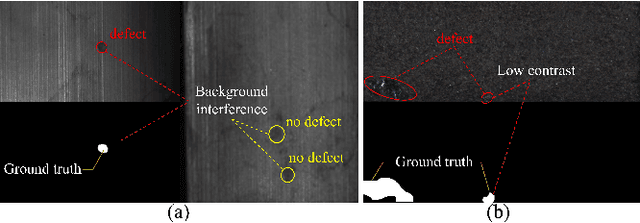
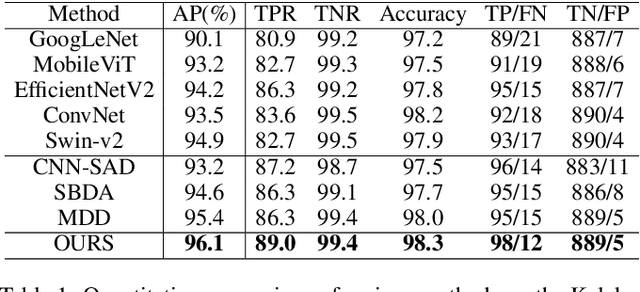
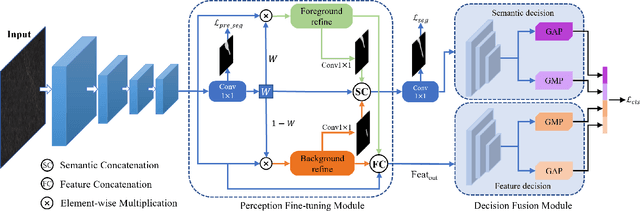
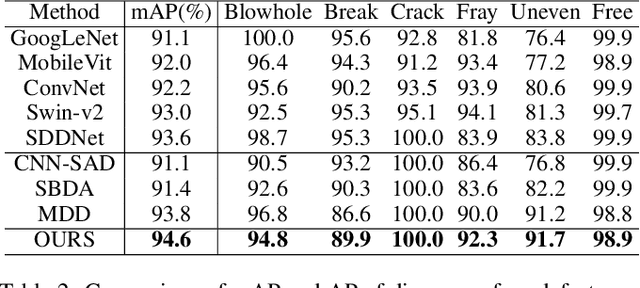
Surface defect inspection is an important task in industrial inspection. Deep learning-based methods have demonstrated promising performance in this domain. Nevertheless, these methods still suffer from misjudgment when encountering challenges such as low-contrast defects and complex backgrounds. To overcome these issues, we present a decision fusion network (DFNet) that incorporates the semantic decision with the feature decision to strengthen the decision ability of the network. In particular, we introduce a decision fusion module (DFM) that extracts a semantic vector from the semantic decision branch and a feature vector for the feature decision branch and fuses them to make the final classification decision. In addition, we propose a perception fine-tuning module (PFM) that fine-tunes the foreground and background during the segmentation stage. PFM generates the semantic and feature outputs that are sent to the classification decision stage. Furthermore, we present an inner-outer separation weight matrix to address the impact of label edge uncertainty during segmentation supervision. Our experimental results on the publicly available datasets including KolektorSDD2 (96.1% AP) and Magnetic-tile-defect-datasets (94.6% mAP) demonstrate the effectiveness of the proposed method.